 |
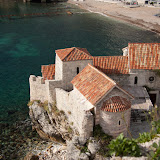
| Montenegro 2009 |
I was going to do these photos in order, but I got bored with Bruges so jumped straight to Montenegro.

|
| Montenegro 2009 |
And now, the end of the 2009 European odyssey.
I am expecting the inevitable question: “Happy to be home?” If it has to be yes or no, then it’s no. I could keep going. I would love to keep going. Constant travelling is a little taxing, but I haven’t reached exhaustion.
Nevertheless, it will be a relief not to think about language anymore, to speak fluently and be understood.
All things end. But this is only the end of the second chapter. Good travel has three phases: the first is planning, when the possibilities excite and the anticipation builds; the second is execution, the trip itself, when plans come to fruition or lead in unexpected directions.
Now begins the synopsis. Trawling through nine thousand photographs. Developing. Discarding. Revisiting notes and blog entries, and assembling articles. Digging out an old brochure to check the name of that church in Portugal, or a receipt to report the cost of a beer in Seville. And beginning work on my next book of photography.
Over the coming months, as I select and develop my best photos, I will post them online. Updates to this blog will be less frequent than they have been during the trip, but check back now and again to see what new photos are available.
In major cities, it’s easy to get by with English. Too easy. Speaking foreign languages is one of the joys of travel. Too many English-speaking tourists turn up in Venice or Paris and speak English. You can't. That's cheating. Aussies are as guilty of this as Americans or the Brits. You’ve got to make an effort.
But the effort does become draining, and the language barrier is isolating. Spaniards are reticent to speak anything other than Spanish, and in provincial Andalucía you won’t get much else. Luckily, my basis in French gets me by with Spanish, and it is probably my favourite language to try to speak.
In Bruges, English is so widely spoken it could be considered a second language after their Flemish Dutch (the national language of French is equally well-spoken, though pride is at stake due to wars with France).
Portugal and England share the oldest alliance in history, and English is widespread in urban areas of Portugal. It is sporadic in rural areas. The elderly, urban or rural, don't speak it at all.
My biggest surprise was Croatia, which easily has the most widespread English of all the countries I toured. It is taught to children in school from young, and the standard is high. This was a bit of a relief, because I have no knowledge of any Slavic language. I was out of luck when I found that just over the border in Montenegro, English is not spoken at all, and I had to depend on my Croatian phrase book (for sensitive cultural and political reasons, Croatian, Montenegrin and Serbian are all officially different languages, but linguistically they are close dialects of the same language).
When I reached France, it was with a mixture of comfort and trepidation. I actually speak a little bit of French, so I could have simple conversations. But I also know enough grammar to know I’m getting my conjugation wrong or that I don’t know which participle to use.

