Showing posts with label Montenegro. Show all posts

Monday, July 27, 2015

Onward to nostalgia

I will admit that after two final nights in Albania, in the northern town of Shkodra, I have had enough of the country. I'm ready to move on.

Saranda in the south is the buzzy Mediterranean entry to the otherwise undeveloped Albanian riviera. It has bars and beaches and a broad, curving boulevard of marble. Gjirokastra and Berati are picturesque hill towns with multi-storeyed whitewashed houses of stone and thick wooden pillars which tumble down from hilltop castles like fields of square boulders. And Shkodra? Sprawling rotten concrete and overflowing rubbish skips.

There is also a well-restored cobbled strip with cafes and bars at one end and a park at the other. But in just four blocks, Shkodra rapidly sprawls away from the arbitrary centre into soiled, broken footpaths and ugly utilitarian buildings, culminating in my hotel.

In the spartan restaurant on the ground floor, where noises echo off the tiled surfaces like a hospital ward, some swaggering Albanian is arguing in English with a girl on his phone. "No, I fucking told you... yes, in England! The fucking UK, bitch... what do you want... sure, I should fucking sell my car?" I shift uncomfortably in my seat and try to tune it out and write my travel notes, but he goes on and on, oblivious that his voice is the only sound in the room. "You don't fucking know... look, I spent time in prison..."—at this I begin packing up—"It was hard for gangsters..."—and start heading to my room. Only now does he finally hang up. Then he starts closing the restaurant. He's staff!

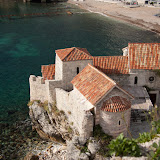
I arrive the next day in Budva. Montenegro is more prosperous than Albania, a fact immediately evident by the state of the roads. The bus hugs the seaside cliffs as below it passes nearby Sveti Stefan, the small luxury island of stone terracotta-roofed houses connected to the mainland by a narrow isthmuslike a speared whale . It was made famous in the 1960s by cinema royalty such as Sophia Loren and Elizabeth Taylor (as well as actual royalty Princess Margaret and Queen Elizabeth herself).

Six years ago I was in Budva. It's a summer resort town, but I was there in October when the storms pelt the coast of the Adriatic and the locals, surly in their off-season colours, bolt their shutters to the fierce winds. Everything was closed and not a tourist was to be seen. Sveti Stefan was still abandoned following the collapse of Yugoslavia. Everyone had gone home. The quiet desolation was all mine.

Now, in July, it is writhing. Budva is party town. The locals have snapped out of their funk and colonies of Eastern European tourists cram the white sandy beaches, plunging into the crystal turquoise waters beneath the craggy limestone cliffs. Crowds throb and clubs thump.

I miss the desolation.

Back then I stayed at the kitsch Hotel Kangaroo. It was a likeably incongruous place, naively cool in its cheesiness and unrelated to anything Australian other than that it was owned by a family who lived for a time in Perth. The decor of my overlarge room was genuine retro with pink flock bedspread and a bathroom of dusty lime enamel, and the restaurant downstairs had one entire wall taken up with a fibreglass bas-relief of a sailing ship, like one of those themed family seafood restaurant in the seventies. The menu was defiantly nonetheless staple Montenegrin meat and fried potatoes. 

But through a little back door in the restaurant was a dimly lit modern cocktail lounge of low tables and clean lines, square purple ottomans and yellow cushions, with Fellini's black-and-white classic La Dolce Vita projected onto the wall to a mellow electronica soundtrack. And the drinks were cheap.

After this discovery I returned the next evening. Happily, La Dolce Vita was playing again and I could watch scenes I had missed the previous night. The music was still good, and I wondered if I might actually have the album. But when I went back the third night and La Dolce Vita was on yet again, I realised why the music was familiar; it was the same album still playing. They just never change it.

I drop in to see if the son on the front desk whom I befriended back then is still here, but he has apparently returned to Australia. Not much else has changed, though. The decor is the same. The portholed ship is still atop the fibreglass waves. Unfortunately the lounge hasn't opened yet. I really wanted to see if they've changed the CD.

Thursday, September 01, 2011

Montenegrin pljeskavica

Montenegro is cheap.  I spent a fortune in Italy.  Although Montenegro is de facto in the euro zone, its economy is not tied to the other euro zone nations; it simply adopted the euro unilaterally.  This goes a small way to explaining why a half litre of beer in Montenegro costs €1.20 and three or four times that in Italy.

At a bar in Bar, I ordered an omelette.  I just got off the ferry from Bari, Italy, and wanted some breakfast while waiting for the train to Podgorica.  The waiter indicated in Serbian that they had no eggs.  I really only ordered it because the word for omelette is omlet, one of only two words on the menu I could understand.  Since the other was hamburger, I ordered that.  He indicated they had no hamburgers.  Off to a rollicking start, this breakfast.  He recommended pljeskavica instead.  "What's pljeskavica?" I asked, and he rattled off something in Serbian and made a shape with his hands.  I shrugged and said, "okay."  I was just hungry.  When travelling, it makes things a lot easier to eat adventurously, and I'm not by nature a fussy eater.  I was ready to try whatever Montenegrin cuisine had to throw at me.

The waiter brought me my pljeskavica.  It was a hamburger.

Monday, March 15, 2010

Photos: Montenegro

Montenegro 2009

I was going to do these photos in order, but I got bored with Bruges so jumped straight to Montenegro.

Sunday, November 15, 2009

Language

In major cities, it’s easy to get by with English.  Too easy.  Speaking foreign languages is one of the joys of travel.  Too many English-speaking tourists turn up in Venice or Paris and speak English.  You can't.  That's cheating.  Aussies are as guilty of this as Americans or the Brits.  You’ve got to make an effort.

But the effort does become draining, and the language barrier is isolating.  Spaniards are reticent to speak anything other than Spanish, and in provincial Andalucía you won’t get much else.  Luckily, my basis in French gets me by with Spanish, and it is probably my favourite language to try to speak.

In Bruges, English is so widely spoken it could be considered a second language after their Flemish Dutch (the national language of French is equally well-spoken, though pride is at stake due to wars with France).

Portugal and England share the oldest alliance in history, and English is widespread in urban areas of Portugal.  It is sporadic in rural areas.  The elderly, urban or rural, don't speak it at all.

My biggest surprise was Croatia, which easily has the most widespread English of all the countries I toured.  It is taught to children in school from young, and the standard is high.  This was a bit of a relief, because I have no knowledge of any Slavic language.  I was out of luck when I found that just over the border in Montenegro, English is not spoken at all, and I had to depend on my Croatian phrase book (for sensitive cultural and political reasons, Croatian, Montenegrin and Serbian are all officially different languages, but linguistically they are close dialects of the same language).

When I reached France, it was with a mixture of comfort and trepidation.  I actually speak a little bit of French, so I could have simple conversations.  But I also know enough grammar to know I’m getting my conjugation wrong or that I don’t know which participle to use.

Wednesday, October 21, 2009

Whew!

I caught the bus back from Montenegro to Dubrovnik, in the south of Croatia, then caught the ferry up the Adriatic Sea to Rijeka in the north, a 22-hour trip.  I booked a cabin for the night, a simple room with two bunks and a bathroom with sink and toilet; no window (an outside cabin costs more).  From Rijeka I had originally intended to stay a night in Rovinj or Poreč in Istria and catch a fast catamaran to Venice, but the service stopped running in early October.  Poreč has some remarkably well-preserved Byzantine mosaics which I was disappointed to miss.  So, instead, I had to kill seven hours in Rijeka, a pleasant-enough-but-not-terribly-interesting town, waiting for a bus to Trieste, from which I boarded a train to Venice.  Which is where I shall stay put for a while!

Kotor

The old Venetian walled town of Kotor is much more interesting than the similarly sized old Venetian walled town of Budva.  Bounded by the Bay of Kotor, the Škurda River, and Mount Lovćen—the “black mountain” that gave the nation its name—it is arguably more beautiful, and with a permanent residential populace it feels more authentic.  Pick-up-sticks-like marble streets open into numerous little plazas for drinking coffee at the cafes, and at only four hectares (ten acres) in size, it is easy to get both lost and found.  I didn’t get time to climb the thousand-odd stairs which run up the mountain on the city walls to a fortress overlooking the turquoise Adriatic fjord on which the city sits.  For 400 years the city fell under the control of Venice, hence the appearance around town of the winged lion of St Mark and the variety of Renaissance palazzos.

Interestingly enough, there was an article in the Sydney Morning Herald about Kotor just the other day.  Click here.

Monday, October 19, 2009

Black mountain, black lung

I met one Montenegrin who didn’t smoke. He was Australian.

At a café on the beach in Budva, when the waiter asked if I needed an ashtray and I said no, he was momentarily stunned. Then he walked away and said, “Good for you.”

Stari Bar

Stari Bar—“old Bar”—is four kilometres away from Bar, an uninteresting port city on Montenegro's south coast. The once populous ancient city is today four hectares of vine-shrouded ruins and piles of stones, a consequence of war and earthquakes, but numerous buildings, already being used to host small concerts and events, are being restored in an effort to develop the site as a historic tourist destination. Those buildings completed are impressive, including an 18th-century Turkish bath house, a Renaissance palazzo and a mediaeval church. Already very pretty in its wild state, it is easy to see what a beautiful drawcard it will become, though with evidence of Illyrian settlement dating from 800 BC the several sites being offhandedly worked with shovels and wheelbarrows raise questions about how much archaeological oversight there is.

I was fortunate to get a lift for the 45-minute drive from Budva with the owner of the hotel where I was staying.  I clambered around the peaceful ruins for four hours, between thick flowering bushes alive with clouds of ecstatic bees, and, lulled by the sound of the river in the valley below, napped on the stone wall of the citadel overlooking wild pomegranate trees and a stone terraced olive grove at the foot of the diagonally-tilted, striated limestone mountain.

Border control

There were only a dozen or so souls on the 3PM bus from Dubrovnik to Podgorice, the capital of Montenegro. I was getting off at Budva, the centre of the action on the Montenegrin coast in peak season. In October, though, stripped of its tourist gloss under gray skies, it is somewhat bleak (as noted in my previous entry).

At the Croatian-Montenegrin border, a policeman boards the bus and collects passports from each of the passengers. He takes them into the border control office to stamp them and then gives them back to the bus driver, who returns them to the owners, a bit of a random process of sometimes checking photos and other times actually passing off the responsibility of distribution to another passenger. The bus travels two minutes up the road, stops at another border check, and we do the same routine all over again. Why? Old bureaucratic communist habit? And what is in between these two stops? No man’s land?

Sunday, October 18, 2009

Budva, Montenegro

There is a certain look of desolation in Montenegro's off season which exposes the communist 1970s Tito hangover it still can't shake.  The promenade to Budva's Stari Grad, the old town in the centre of the Montenegrin Adriatic coast, is bounded by impermanent single-storey aluminium and concrete shops and weed-strewn lots.  The pedestrianised street is paved with concrete blocks, and a cracked basketball court next to a fibreglass waterslide held up by rusted scaffolding is used as a go-kart circuit.  Half the shops and most of the bars, tacky ones in the shape of pirate ships between palm trees and dead neon signs, are closed due to the off season.  "Fisherman's Pub" is decorated with the typical pastiche of hanging lifesavers, floats and fishing nets.  Though trite, these are used and faded objects taken from actual fishing boats; it's an authenticity that deserved recognition thirty years ago but which is now an eastern bloc curiosity.

Past all this, moored next to the walls of Stari Grad is a bank of expensive cruisers. Inside the old town of 17th-century walls it's suddenly upmarket with expensive watches and jewellery, cafes and restaurants... yet it's a bit like a shopping mall.  There are almost no residences.  Compare this to Split, Dubrovnik, and Kotor, further north on the Montenegrin coast, where the character difference is distinct; they are still residential towns, and there is a life buzzing around the tourists.

Apparently, Budva in the summer high season of July and August is a different thing entirely.  The swarms of bikini-clad girls and crazy nightlife every night are enough to distract one from, well, everything else (including perhaps a good night's sleep).

Wednesday, October 07, 2009

Adventure!

Constant travelling place to place is a continual cycle of anxiety, triumph and departure.  You venture into unknown territory, not uncommonly getting lost, and establish yourself in a strange place.  After orienting yourself, things become familiar and you’re comfortable enough to enjoy the novelty and newness of everything.  You even become a minor authority and pass on recommendations to fellow travellers.   Then you move on—sometimes it’s bittersweet when you leave a favourite place—and the anxiety begins anew.  It’s a slow-burn adrenaline rush.

I’ve stuck largely to my planned itinerary on this trip, adjusting it only slightly to stay a day longer in Mertola or Tomar, or dropping a destination like Elvas or Viseu because I try to do too much.  I think Croatia and Montenegro will be even more fluid, as it was planned with the least rigour and because my itinerary has now gained two days.  I had planned to raft Montenegro's Tara Canyon, but I have just learned that the rafting season is now over.  October is late, but some years the water is still strong enough for rapids.  It must have petered out.