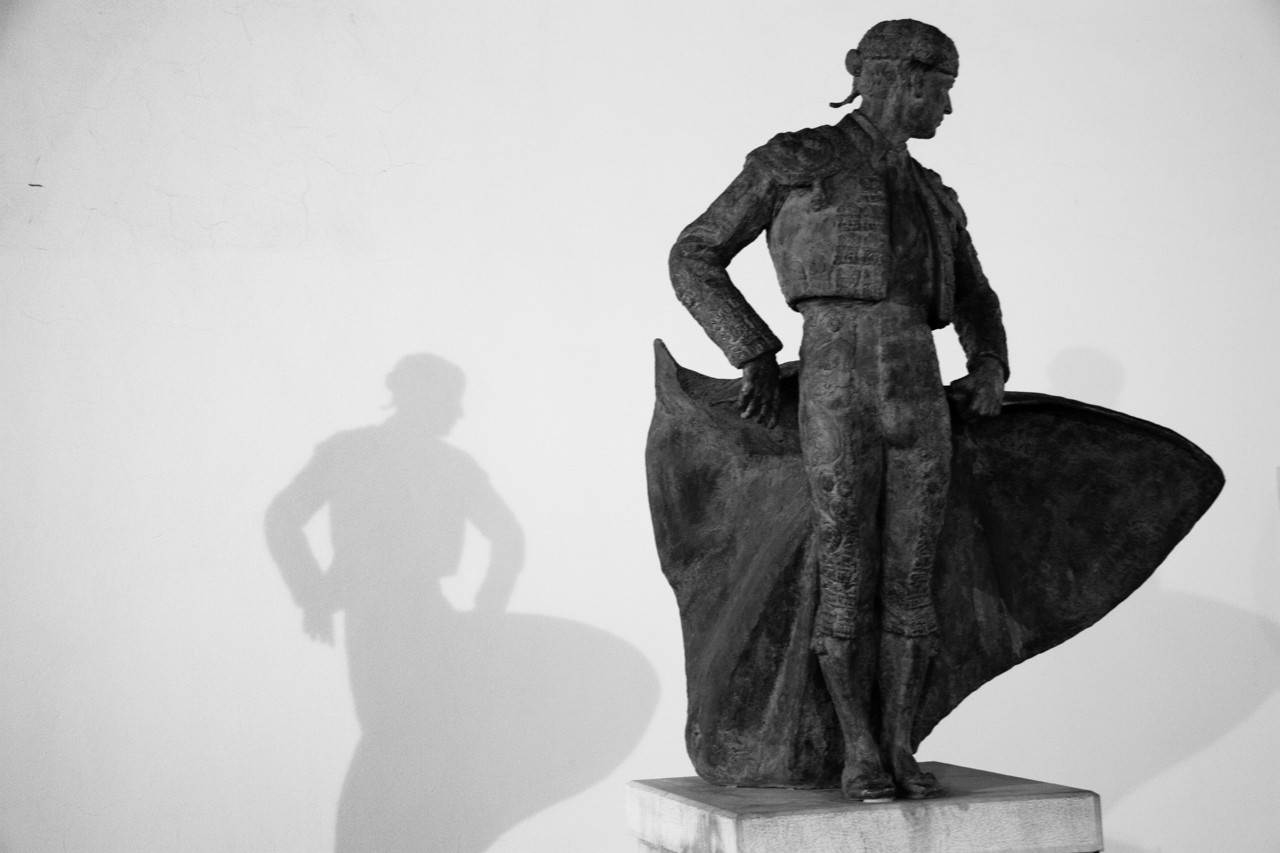
Sunday, August 28, 2016

Lost in Spain: episode 5

EPISODE 5: The ticket

The blindfolded horse leans into the bull, unsteady but protected from the horns by the heavily padded armour that extends to its knees. As he strains to try to lift the horse, black muscles tensed, the bull is gored in the shoulder with a lance by the mounted picador.

El Toro disengages. The cape-waving cuadrilla draws him away as three banderilleros on foot enter the ring. Each is holding a pair of short, barbed spears tightly adorned with coloured ribbons. The first stands tall on his toes with arms outstretched in a T, posing like a mantis with spears pointing down to receive the bull. El Toro sights him, backs up, paws the ground and charges. With an arched leap the banderillero dodges his swinging horns and thrusts the spears into his withers.

• • • 

I wander.

Through the town, dodging the thronging people. Past the great white curving rampart of the plaza de toros and the tiny arrow slit of a ticket window—closed. Past the contiguous walls of white painted homes boot-topped with bands of saffron or salmon. Past windows caged behind delicate skeletons of the same wrought black iron that encases parapet-like balconies above.

And past a little restaurant with a man sitting sidelong inside a street-facing reception window, with a tiny handbill stuck on the glass that halts me. It's an advertisement for tickets to the three weekend corridas—including the Goyesca.

I point to it. “Esta la Corrida de la Goyesca disponible? Is the bullfight available?”

“Sí. €100 por sol alto.”

I'm stunned. A ticket! Right in front of me!

Sol alto are the cheapest seats. They're in the upper tier, furthest from the ring. Sol—in the hot sun. No shade. And while they're not €2,000, even in this second year of the Spanish recession they're still no bargain. I hesitate, thumbing my euros, gauging all that I have spent to get here. Should I just commit to finishing it? Finding a ticket at all is unbelievable luck. And after everything, haven't I earned this privilege? Isn't this my prize?

“Pues?” asks the man. Do I want it or not?

So here I am, despite all expectations, squinting through the dust-speckled light of the hot afternoon sun. There's a spicy smell of cigarillos in the air. I'm sitting on a bench in the highest seats, on a little square cushion rented for two euros, with a spirited crowd. I have prevailed. It's 38 degrees and the Goyesca, on its sixth bull, is into its third hour.

Sunday, August 21, 2016

Lost in Spain: episode 4

EPISODE 4: Veni, vidi, vici...

El Toro charges through the wooden gate and into the ring, locking his front legs and skidding five-hundred kilograms of black brawn to a halt in the yellow sand. He snorts, tossing his head side to side, and careers at a pink and gold cape waving on the far side of the ring. The torero ducks behind a barrier. A second cape waves from across the arena. Careening away, the bull speeds from one fluttering capote to another as each appears, distracts and vanishes. Until he sees the horse. He stops, turns and slams his horns into the horse's side.

• • •

Even the vivid vicissitudes of getting here can't thwart me. I have arrived.

The town bakes under the dry heat and bright light of a late Andalusian summer. Visitors in straw summer hats and short-sleeved shirts have crowded festive streets strung with a canopy of paper balls coloured yellow, red, blue and green. Local young ladies are wearing colourful, ruffled dresses and baubled silk mantillas draped from tall peinetas in their hair. They flit fans at fine-looking riders with round-rimmed hats on horseback. Everywhere there is celebration, vitality, a real fiesta, with strains of laughter and flamenco in the streets.

After a few incredulous phone calls by the hotel receptionist, I have been directed down the packed Calle Molino to a hotel in La Ciudad that has had, to my great fortune, a cancellation. I triumphantly pocket the keys from the rental car and clap my hand on a horse's flank in jubilance.

Ronda's old town of La Ciudad is connected to the newer cliff-top quarter of El Mercadillo by the spectacular arched Puente Nuevo. Towering above the Guadalevín River over a hundred metres below, this “New Bridge” was completed in 1793, superseding the old one further down the Tajo gorge.

In the Spanish Civil War, an inegressible chamber embedded inside the bridge's central arch was used to hold political prisoners. It is still there. Antonio Ordóñez's good friend Ernest Hemingway, who lived in Ronda part-time, wrote in For Whom The Bell Tolls of Nationalist sympathisers being thrown by Republicans from the cliffs of an Andalusian village. It is supposedly a factual account.

Ronda has a bloody history. It was forged in war, founded by the Roman general Scipio Africanus as an outpost to fight Rome's arch-foe, Hannibal of Carthage. Ever since, it has swung between life and death. Conquered by the Suebi in the fifth century and reconquered by the Byzantine Empire in the sixth, it was sacked by Visigoths and traded between warring tribes of Islamic Moors for the next five hundred years. In 1485 it was subjugated by the reconquista of the Catholic monarchs Fernando and Isabel. In 1808 Napoleon cut the population down to a third when, with guerilla tactics, the Rondeños resisted his invasion.

This weekend's population would have dwarfed Napoleon's entire army. Ronda has swelled a hundred-fold. The streets are closed to traffic just to fit them all. I check into my hotel, toss my backpack on the bed and go searching—without a clue how—for a scarce ticket to the bullfight.

Sunday, August 14, 2016

Lost in Spain: episode 3

EPISODE 3: Todo completo

Finally a petrol station emerged at a remote highway junction. I pulled in and jumped out. The glass door, obscured of transparency by a crooked gallery of smudged and faded signs (abierto, tirar, Castrol) slid stiffly open. Far from the sanitised, bright white service station in Córdoba, it smelled like a real, proper garage: black, like rubber and grease.

I bypassed the windshield wipers and aisles of motor oil and headed to the back wall of the shop, where a pegboard hidden in the gloom held a small cache of pamphlets. Poking out of a little shelf like a cheeky tongue was an orange booklet I immediately recognised.

Michelin's excellent fold-out map of Andalucía. I was found.

The drive from Córdoba to Ronda takes two-and-a-half hours, but I was rapt to pull it off in five—and grateful for air conditioning. It must have been 40 degrees Celsius. Bloody hell, I thought. I don't want to lug my pack far in this. Without a navigator to read the map I entered Ronda blind and hunted for a parking lot I hoped was close to the festivities.

Parking a car in the old town's choked and narrow streets is an absurd idea. The Feria de Pedro Romero is Ronda's biggest festival of the year, and it attracts an influx of tourists that would turn Christ himself misanthropic. But a miracle upon me, I chose a parking lot little more than a hundred metres from the centre of the old town. Sheer providence. I could not have found somewhere closer if I knew what I was doing.

The man in the wooden booth of the dusty dirt lot charged me the fiesta price of €24-for-24-hours, and I hauled my pack to a nearby hotel to enquire about a room.

Señor, it's the feria,” said the lady at reception. “Todo completo. All the hotels are full!”

Sunday, August 07, 2016

Lost in Spain: episode 2

EPISODE 2: Where the hell is Ronda?

Dramatic, cliff-top Ronda is on the edge of the Córdoba-Sevilla-Málaga triangle, a broad and rolling plain of vast skies, sweeping grainfields and long olive groves ringed by minor mountain ranges and linked by secondary roads that slink out of antique provincial hill towns. Without GPS you need a decent road map.

Michelin makes an excellent, 1:400,000 scale detailed concertina-fold map of Andalucía. I have it. In Sydney. I'd planned to catch the train to Ronda; why the hell would I pack the map? Instead, the rental agency gave me an A3-size branded place mat demarcating the entire 87,000 square-kilometre region. I squinted at it, and could make out that I was north and Ronda was south. Perfect, I thought. If I don't make it by nightfall I can just navigate by the stars.

Five minutes into my road trip I was hopelessly tangled in city interchanges. I aborted my endless figure eights and death spirals and pulled into a service station in search of a proper map. Quite sensibly they had nothing of the sort, which might tie up shelf space for chocolate bars and ¡Hola! celebrity gossip rags, so I spent the next half hour poring over tiny charts in guidebooks and brochures and muttering through clenched teeth in the front seat of the car before the obvious hit me: I have Google Maps on my mobile phone! I'd been avoiding using it so I wouldn't be slugged with roaming charges, but with financial concerns already out the window I fired it up and Googled directions. Fifteen minutes later I shot out of the city.

Adiós Córdoba!” I bid. “Ronda, I am on my way!”

The regional roads of the southern province snake between whitewashed Andalusian towns—Écija, with its elaborate church towers jutting above the settlement like upturned table legs, Osuna surrounded by fields of sunflowers in ochre soil, and hilltop Olvera with its imposing church and Moorish castle. The great azure vault above, blindingly bright in the height of the day, spans a patchwork of land. Fields of brown dirt and straw grass alternate with hopscotch plots of low olive trees studded in precise green rows that shift in parallax as you pass them.

The sun was warm through the windshield. I drifted into a sinuous leisure as the shimmering grey ribbon of road flowed through the rural terrain, past the occasional walled farmhouse and hacienda ruin. Multi-storeyed stacks of golden hay bales in great edifices mimicked office blocks on the rural landscape.

A sudden fork in the road roused me from my languor. I pulled over and consulted Google. But there was no map. On my journey from navigational despair to digital salvation I failed to account that a hundred kilometres into the Spanish plains there is a rather complete absence of reception. My mobile phone was only useful now for beating against my head in rebuke: being lost in urban Córdoba was preferable to being lost in expanses of nowhere.

It was fifty-fifty and I wasn't getting any closer to Ronda sitting there. I picked a branch and drove on.

Thursday, August 04, 2016

First Friday Fotos

The fería de Pedro Romero in Ronda, Spain

Horses and drivers in fería garb
Carriage driver


Local girls at the fería
Poster of the fair


First Friday Fotos

The fería de Pedro Romero in Ronda, Spain

The parade of carriages
Passenger and driver


Cayetano Ordoñez, patriarch of the bullfighting family
Ronda's Puente Nuevo