Spaniards are drinkers of coffee, not tea, but in the ancient land of the Moors you can find teterías, Moroccan-style tea houses bedecked in tilework, ottoman cushions and rugs. They are more a commercial conceit than a vestige of culture, but are nevertheless mini Meccas for the deprived tea lover.
When I learned about the Salon de Té Al-Zahra in Ronda, which offers over a hundred different teas, I made a beeline. A darkened series of low-ceilinged rooms with red walls, the décor was cozy but the air was smoky and hot. There’s no ventilation in these deep old buildings, and non-smoking establishments are a very non-European idea (though France is apparently catching on). Since recovering from this flu, if I spend the evening in a smoky restaurant – which is inevitable in Spain if you want to eat – I spend the night coughing myself to sleep. But after two weeks of abstinence, I’ll do anything for a decent pot of tea.
In Jerez de la Frontera, the Tetería La Jaima has very high ceilings and is much better ventilated. Even the hookahs they have on the menu are barely noticeable. The teapots come in three sizes, and I ordered a grande, which typically serves four or five people. The waitress double-checked, thinking my Spanish must be bad.
“Grande? Por uno solo? Es mucho mucho.”
“Si,” I smiled.
It was served in a decorative brass teapot and filled my glass a dozen times.
Unpredictably, the most pleasant tea house I’ve found in Europe is in the medieval Bohemian town of Cesky Krumlov in the Czech Republic. After seating yourself under a large tree in the garden, the bearded waiter in flowing pantaloons brings a hundred-kind menu of black, green and white teas, with milk or lemon, spiced with cinnamon, anise, roses, or even chocolate, and a little brass bell. You while away the day in the shade of the tree, and whenever you want another pot of tea, you just ring the bell.

Showing posts with label Cesky Krumlov. Show all posts
Showing posts with label Cesky Krumlov. Show all posts
Friday, September 11, 2009

Saturday, August 30, 2008
Photos: Czech Republic
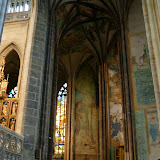
There are more photos to come, but for now, here is the Czech Republic. Click on the thumbnails.
 |
| Prague |
 |
| Kutna Hora |
 |
| Cesky Krumlov |
Friday, July 18, 2008
Czech recap

The smaller towns in Europe are always more enjoyable than the big cities.
Prague is very pretty and well-preserved, and certainly worth visiting, but
it still bustles as a metropolis. That is amplified by the hordes of
tourists, and while it is easy to find quiet lanes out of the tourists'
way, it's a bit like Saturday night in Sydney every night in Prague. The
locals appear quite jaded by it. The worst appear to be British and Italian
groups of loud drunk blokes who holler up and down the streets at four in
the morning, though quite a number of other (Eastern) European tourists
bring their own special type of odorific offence, like the fat old Polish
woman sweating garlic sausages who bowled us right out of a shop.
Cesky Krumlov, while also unavoidably touristy, is intimate and friendly,
comparably beautiful with Prague, and easily digested in three days. All
the 17th-century buildings perched all over the little hill in the crook of
the river are painted pinks and greens and reds and overlooked by the
castle on the hill with the multicoloured tower. There is a tea house there
with Arabian rooms full of cushions and a quiet garden where "master tea
brewers" serve countless types of tea from China, India, Africa and Latin
America with spices like cardamom, cloves, white pepper and chocolate. You
can even smoke perfumed tobacco in a shisha, or hookah.
The preservation and restoration of buildings is done supremely well by the
Czechs. There is almost never graffiti to be seen in the well-maintained
old town centres. Although a minor aesthetic nuisance for photography,
there's always restoration scaffolding up somewhere.
When you get out of the historic centres, there are some interesting
buildings understandably maintained with considerably less enthusiasm --
monotonous crumbling grey concrete slabs of flats from the Communist era,
which is rather improved by its graffiti.
Thursday, July 17, 2008
Cesky Krumlov


Republic, with many days overcast or raining. We did have one nice day in
Prague, though, and today in Cesky Krumlov is bright and sunny.
Krumlov, near the border of Austria, is a quaint and beautiful cobblestoned
town nestled in a meander of the Vltava River. As you'd expect, it is
hugely popular with the tourists. Of course, that also means the food,
entertainment and amenities are excellent. Tonight, our last of three here,
we are going to a concert of "secular music of Renaissance Europe," part of
the ancient music festival.
Tomorrow... Salzburg.
Subscribe to:
Posts (Atom)