Constant travelling place to place is a continual cycle of anxiety, triumph and departure. You venture into unknown territory, not uncommonly getting lost, and establish yourself in a strange place. After orienting yourself, things become familiar and you’re comfortable enough to enjoy the novelty and newness of everything. You even become a minor authority and pass on recommendations to fellow travellers. Then you move on—sometimes it’s bittersweet when you leave a favourite place—and the anxiety begins anew. It’s a slow-burn adrenaline rush.
I’ve stuck largely to my planned itinerary on this trip, adjusting it only slightly to stay a day longer in Mertola or Tomar, or dropping a destination like Elvas or Viseu because I try to do too much. I think Croatia and Montenegro will be even more fluid, as it was planned with the least rigour and because my itinerary has now gained two days. I had planned to raft Montenegro's Tara Canyon, but I have just learned that the rafting season is now over. October is late, but some years the water is still strong enough for rapids. It must have petered out.

Tuesday, October 06, 2009

This is boring
As amused as I was that I could say I’ve been to Pisa but didn’t see the Leaning Tower, my reporting responsibilities overruled my sense of humour and I got up early on the morning of my flight to dash up to the Piazza dei Miracoli. Lonely Planet compares this square, which also features Pisa’s Romanesque cathedral and baptistry, to Venice's Piazza San Marco as one of Italy’s most memorable. Having spent a full fifteen minutes there and not (yet) having been to Venice, I can say with complete authority that that’s rubbish. It’s boring. Apart from visiting these monuments there’s nothing to do. The piazza is all grass, surrounded by a wall and a street. There is no reason to linger, and indeed, nobody does. It is surprisingly sterile. And though I probably would have entered the cathedral had I had time, I don’t go in for tourist compulsions like climbing the Leaning Tower. I climbed the Eiffel Tower once, but only after I’d already been to Paris before, and I didn’t find it especially memorable. It’s not even good for a photograph; high panoramas or distant landscapes are also boring.
The art of photography is similar to the art of writing well: the writer should suggest the whole with just a detail, and allow the reader’s imagination to complete the picture. Landscapes are too vast and any subject is lost in the innumerable details. A good photograph doesn’t have too many competing subjects. There seems to be an inverse relationship between scale and interest: panoramas make as dull pictures as an entire chapter of description makes dull reading.
Hello? Are you still there?
The art of photography is similar to the art of writing well: the writer should suggest the whole with just a detail, and allow the reader’s imagination to complete the picture. Landscapes are too vast and any subject is lost in the innumerable details. A good photograph doesn’t have too many competing subjects. There seems to be an inverse relationship between scale and interest: panoramas make as dull pictures as an entire chapter of description makes dull reading.
Hello? Are you still there?
Sunday, October 04, 2009
The Odyssey
First there was Tartarus.
It is not easy to get from the Siena train station, 2km out of town, to the historic centre. Usually I prefer to walk if I can, but Lonely Planet obscured the position of the station on their map with the reference listing. They say in the guide, “buses Nos 8, 9 and 10 run between the train station and Piazza Gramsci” at the edge of the pedestrianised old town. This is not entirely true, as it suggests a shuttle which goes to and fro. What they neglect to state is that the number 10 does not simply return to the train station. It continues on to tour the outlying Siena suburbs in a 40km loop, for which I waited 20 minutes to do on a bus with no shocks helmed by Slayer’s ex-drum roadie working the pedals over roads patched more times than a chain smoker gone cold turkey before being returned to the spot where I boarded. I understand that getting lost is part of travelling, but this is one time that the otherwise reliable Lonely Planet has failed.
I got off the bus where I got on and walked the two kilometres to the train station, where I found that the 18:41 train didn’t arrive or even exist, despite being posted on the timetable. The missing 19:18 must go to the same destination. So, I tried to catch the 19:41 which, according to the departures board, was leaving from platform 1 TR. At 19:38, when a train berthed at platform 1, naturally I boarded. But you see, Siena train station has six platforms, 1 through 5. It’s perfectly logical: there is a hidden platform, actually in the dark, at the far end of platform 1 and obscured by the building, called “Platform 1 Tronco (truncated).” When the train I boarded wasn’t moving by 19:45 I realised that it was indicating a different destination, and after some scrambling noticed somebody running into the dark at the end of the platform and boarding a train—my train—which promptly departed.
So, I finally caught the 20:18. In the end, it took me an hour and forty-five minutes to get to Siena and five hours to return. I was aiming to get back before sunset so I could at least get a photo of the one thing I can now say I have not seen despite having been to Pisa—the Leaning Tower.
It is not easy to get from the Siena train station, 2km out of town, to the historic centre. Usually I prefer to walk if I can, but Lonely Planet obscured the position of the station on their map with the reference listing. They say in the guide, “buses Nos 8, 9 and 10 run between the train station and Piazza Gramsci” at the edge of the pedestrianised old town. This is not entirely true, as it suggests a shuttle which goes to and fro. What they neglect to state is that the number 10 does not simply return to the train station. It continues on to tour the outlying Siena suburbs in a 40km loop, for which I waited 20 minutes to do on a bus with no shocks helmed by Slayer’s ex-drum roadie working the pedals over roads patched more times than a chain smoker gone cold turkey before being returned to the spot where I boarded. I understand that getting lost is part of travelling, but this is one time that the otherwise reliable Lonely Planet has failed.
I got off the bus where I got on and walked the two kilometres to the train station, where I found that the 18:41 train didn’t arrive or even exist, despite being posted on the timetable. The missing 19:18 must go to the same destination. So, I tried to catch the 19:41 which, according to the departures board, was leaving from platform 1 TR. At 19:38, when a train berthed at platform 1, naturally I boarded. But you see, Siena train station has six platforms, 1 through 5. It’s perfectly logical: there is a hidden platform, actually in the dark, at the far end of platform 1 and obscured by the building, called “Platform 1 Tronco (truncated).” When the train I boarded wasn’t moving by 19:45 I realised that it was indicating a different destination, and after some scrambling noticed somebody running into the dark at the end of the platform and boarding a train—my train—which promptly departed.
So, I finally caught the 20:18. In the end, it took me an hour and forty-five minutes to get to Siena and five hours to return. I was aiming to get back before sunset so I could at least get a photo of the one thing I can now say I have not seen despite having been to Pisa—the Leaning Tower.
Five lands
I was very excited to get to Cinque Terre, a clutch of villages clinging like barnacles to rocky slopes above the Mediterranean. Not only have I wanted for many years to go, but hiking six kilometres of precipitous footpaths between coastal Italian villages was a complete change from driving highways for three weeks between inland Portuguese cathedrals. Exactly as prescribed by the proverbial practitioner.
From Pisa it is very easy to get to Riomaggiore, taking under two hours on the train, including wait time changing at La Spezia. I then walked as far as Vernazza, only reaching quattro of the cinque townships as I ran out of light by 7PM and decided to abandon Monterosso. The walk is renowned for its prettiness: the path strings along cliffs between clusters of orange, green, pink and yellow buildings, with turquoise waters and beaches of ocean-rounded stones below. There is the crash of the breaking surf and, as if a distant shower of fireworks, the cracking, crumbling sound of the tide rolling the stones like racking billiard balls.
In Corniglia I ate a pasta specific to the region (I bet every region in Italy has a unique shape of pasta), the name of which I can't recall, in pesto made with local basil, a specialty here. Simple and delicious. Italian food is all about quality and simplicity, and what a delight it is after weeks of Portuguese meat.
From Pisa it is very easy to get to Riomaggiore, taking under two hours on the train, including wait time changing at La Spezia. I then walked as far as Vernazza, only reaching quattro of the cinque townships as I ran out of light by 7PM and decided to abandon Monterosso. The walk is renowned for its prettiness: the path strings along cliffs between clusters of orange, green, pink and yellow buildings, with turquoise waters and beaches of ocean-rounded stones below. There is the crash of the breaking surf and, as if a distant shower of fireworks, the cracking, crumbling sound of the tide rolling the stones like racking billiard balls.
In Corniglia I ate a pasta specific to the region (I bet every region in Italy has a unique shape of pasta), the name of which I can't recall, in pesto made with local basil, a specialty here. Simple and delicious. Italian food is all about quality and simplicity, and what a delight it is after weeks of Portuguese meat.
The human bookcase
Flight routes to Croatia all end in September. The only feasible route for me to get from Portugal to Croatia in October is to fly RyanAir and stop over for three nights in Pisa, Italy.
This time, I avoided RyanAir’s excess baggage fees by wearing a fleece jacket stuffed full of six language phrasebooks, a book on philosophy, numerous maps and all my travel guides. I looked like a cross between a Series 4000 mechanoid and a geodesic dome.
It is ridiculously easy to get from the Pisa airport to my hotel. The airport and the train are not exactly modern, but the train trip takes literally five minutes, and my hotel is less than a hundred metres from Pisa Centrale. This was intentional; I am making two day-trips by train to Cinque Terre and to Siena, so I wanted to be close to the station.
This time, I avoided RyanAir’s excess baggage fees by wearing a fleece jacket stuffed full of six language phrasebooks, a book on philosophy, numerous maps and all my travel guides. I looked like a cross between a Series 4000 mechanoid and a geodesic dome.
It is ridiculously easy to get from the Pisa airport to my hotel. The airport and the train are not exactly modern, but the train trip takes literally five minutes, and my hotel is less than a hundred metres from Pisa Centrale. This was intentional; I am making two day-trips by train to Cinque Terre and to Siena, so I wanted to be close to the station.
Friday, October 02, 2009
All right, already.
I have seen more convents, cathedrals and castles than I can now distinguish. Germany and Portugal have so many castles between them that in my mind’s eye they all look alike; as I review the photos, I can’t tell which one is where without cross-referencing the date on my itinerary.
 While the German castles on the Rhine were built by robber-barons, many of the Portuguese castles were built by the mysterious Knight Templar monks, such as the ruins of the castle at Constançia, or the castle ruins at Monsanto.
And I’m over them.
Goodbye Portugal. Hello, Italy!
 While the German castles on the Rhine were built by robber-barons, many of the Portuguese castles were built by the mysterious Knight Templar monks, such as the ruins of the castle at Constançia, or the castle ruins at Monsanto.
 And I’m over them.
Goodbye Portugal. Hello, Italy!
Roman mosaics
And, of course, all this discussion of photography made me look through my photos, and so many I want to share, so here is another.
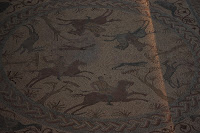
Conimbriga is the largest excavated Roman site in Portugal, and the mosaics unearthed are the most complete (albeit restored) and impressive that I have ever seen, and having a penchant for Roman mosaics I have seen many. This one depicts horsemen on a hunt. My favourite (though much less detailed) is a mosaic of a maze with the minotaur at its centre.

Memory
Speaking of photos, I bought a 320GB external USB hard drive for my laptop to back up all my photography. It is the most feasible solution. I initially anticipated I would take about 100GB of photos, but at the rate I’m going I will need double that. The online site I have been using for backing up photos is a nice idea in theory, because of the redundancy protection and the fact that I could have everything stolen and still have my photos, but in practise it just isn't workable. The upload rate of broadband is typically a quarter of the download rate, so I have only backed up about a third online.
Where are all the photos?
Some weeks ago I promised I would upload some photos from time to time. This is just too arduous. At this stage, halfway through my trip, I have about 6,000 photos.
But nevertheless, here is one. It's not grand photography; it's simply a good example of the variety on a Portuguese menu. Click on it so you can read it.
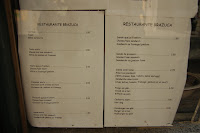
But nevertheless, here is one. It's not grand photography; it's simply a good example of the variety on a Portuguese menu. Click on it so you can read it.

Portuguese monasteries
Beginning with the Mosteiro dos Jerónimos in Lisbon with its ornate stonework, I did the monastery circuit in Portugal—Batalha, Alcobaça, and Tomar. These towns host architecturally astonishing abbeys that are perhaps the most significant in the country.
The monastery at Batalha was built to commemorate Dom João’s victory in the 1385 Battle of Aljubarrota. The defeat of King Juan of Castile in a contest for the Portuguese throne was one of the most consequential battles in European history, given that it assured Portuguese independence prior to their initiation of Europe’s imperial expansion and colonisation across the globe, the so-called Age of Discovery, with Vasco da Gama’s establishment of a sea route to India. The elaborate architecture and sculpture of the convent at Batalha (which means “battle” in Portuguese) reflects the importance of this event.
At Alcobaça, the interior of the severe but grand Romanesque hall church contrasts its Manueline façade, while the gigantic kitchen of the abbey itself is indulgence manifest. The chimney is three storeys tall and is large enough at its base to envelop a car. A small tributary was dug from the nearby river and diverted through the kitchen to supply the monastery with fresh fish. Hardly a monks’ existence.
The massive, 12th-century Convento do Cristo in Tomar, the headquarters of the legendary Order of the Knights Templar, is the most atmospheric—and the largest. I spent four hours hurrying to see everything. The highlight is the staggering charola, or Round Church. An octagonal rotunda with a ceiling perhaps ten metres tall containing a central structure connected by arches—the high altar—is intricately decorated with sculptures and paintings. Legend has it that the knights attended mass here on horseback.
The monastery at Batalha was built to commemorate Dom João’s victory in the 1385 Battle of Aljubarrota. The defeat of King Juan of Castile in a contest for the Portuguese throne was one of the most consequential battles in European history, given that it assured Portuguese independence prior to their initiation of Europe’s imperial expansion and colonisation across the globe, the so-called Age of Discovery, with Vasco da Gama’s establishment of a sea route to India. The elaborate architecture and sculpture of the convent at Batalha (which means “battle” in Portuguese) reflects the importance of this event.
At Alcobaça, the interior of the severe but grand Romanesque hall church contrasts its Manueline façade, while the gigantic kitchen of the abbey itself is indulgence manifest. The chimney is three storeys tall and is large enough at its base to envelop a car. A small tributary was dug from the nearby river and diverted through the kitchen to supply the monastery with fresh fish. Hardly a monks’ existence.
The massive, 12th-century Convento do Cristo in Tomar, the headquarters of the legendary Order of the Knights Templar, is the most atmospheric—and the largest. I spent four hours hurrying to see everything. The highlight is the staggering charola, or Round Church. An octagonal rotunda with a ceiling perhaps ten metres tall containing a central structure connected by arches—the high altar—is intricately decorated with sculptures and paintings. Legend has it that the knights attended mass here on horseback.
Subscribe to:
Posts (Atom)